
Why September Is the Most Important Month for Q4 Ecommerce
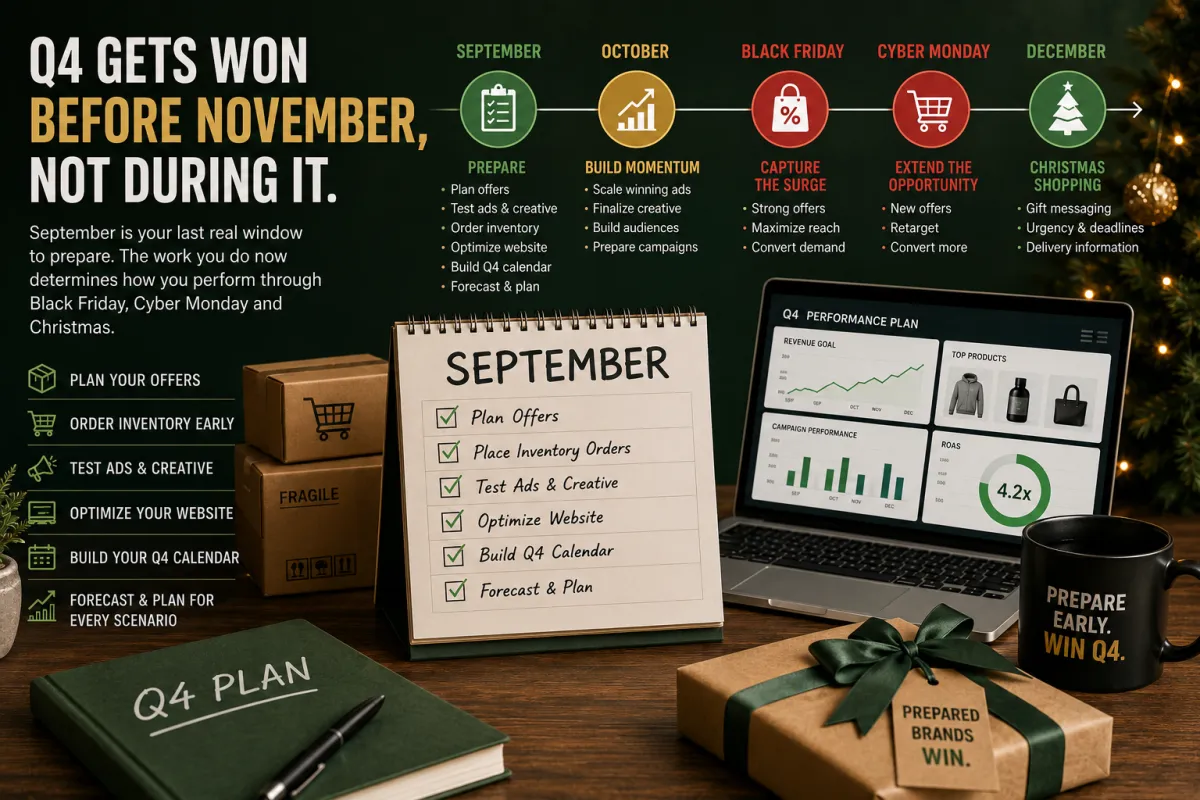
Q4 gets won way before November, not during it.
If you're a Shopify or Amazon founder, September can feel deceptively quiet. Sales haven't picked up yet, customers aren't in Christmas mode, and Black Friday still feels miles away.
That quiet is exactly why September matters so much. By November, ad costs climb, suppliers get slammed, and your team is firefighting instead of planning. September is your last real window to get ahead of it: to decide what you're selling, get stock on order, test your ads, and build the cash runway to actually enjoy Q4 instead of just surviving it.
Let's get into it.
September Isn't Quiet. It's Prep Season.
The most common mistake we see founders make is treating September like any other trading month, then scrambling to prepare in late October. Here's the thing. Q4 isn't one event. It's a sequence:
Black Friday → Cyber Monday → Christmas shopping → last-minute gifting → post-Christmas demand.
Each stage has its own customer mindset, its own messaging, and its own operational pressure points, especially on cash. If you're only planning for Black Friday, you're already under-planning for the ten weeks around it. September is where you build the infrastructure for the whole run.
1. Decide What You're Actually Selling
Before you touch ad spend, get clear on which products deserve the attention. Pull up your sales history, your margins, and your current stock position, and identify:
Your best sellers
Your highest-margin products (the ones that actually move the needle on profit, not just revenue)
Products that make strong gifts or bundle well
Products you can genuinely scale with the stock you have
Anything that needs reordering right now
Not every SKU needs to be a Q4 hero. Trying to push everything at once dilutes your marketing budget and, just as importantly, spreads your cash across too many bets. September is when you decide where your attention, budget, and stock should go.
2. Place Your Inventory Orders Early
This is the one founders most often leave too late, and it's as much a cashflow decision as a stock decision.
You can't advertise stock you don't have. If a product takes off in November and your supplier needs six weeks to deliver, you've potentially missed the most valuable trading period of the year. Work backwards from your Q4 sales expectations:
How much stock do you need for October, for Black Friday and Cyber Monday, and for December?
How long does your supplier actually take, end to end?
What buffer do you need if sales beat forecast?
Inventory planning isn't about predicting the future perfectly. It's about giving yourself room to respond. And a big purchase order now means a real dent in your cash position before the sales land, which is exactly why it needs to be planned rather than improvised. An early order gives you options. A late one gives you none.
3. Build Your Q4 Offers Before Q4
Don't wait until Black Friday week to decide what you're actually offering. Work through your promotional strategy now:
Percentage or fixed discount?
Bundles, or buy-more-save-more?
Free shipping, gift with purchase, or exclusive products?
And think past Black Friday itself. Your Black Friday offer shouldn't accidentally cannibalise your December margin, so map out the full journey: one strategy for Black Friday and Cyber Monday, and a different one as you shift into Christmas gifting and urgency. Deciding early gives your team real time to build the campaigns properly, instead of throwing them together in a panic.
4. Start Testing Your Ads Now
September isn't the month to spend your whole Q4 budget. It's the month to learn. Start testing the creative, messaging, products, and audiences you plan to lean on later. Find out what gets attention, what drives clicks, what actually converts, and just as usefully, what doesn't.
Failure in September is useful data. Failure on Black Friday is expensive, full stop. The goal is to walk into November with proven concepts, not a pile of untested ideas and a maxed-out ad budget.
5. Build Your Creative Bank
Creative production becomes a genuine bottleneck once Q4 hits. Suddenly everyone needs Black Friday ads, Cyber Monday ads, Christmas ads, gift ads, urgency ads, last-shipping-date ads, in a dozen formats for a dozen platforms. If you're building all of that in November and December, your creative team is already behind before they've started.
Use September's breathing room to build a bank of hooks, angles, product demos, UGC, and lifestyle assets around your key products. You don't need to know exactly which one wins. You just need enough quality creative on hand to test, learn, and move fast when it counts.
6. Get Your Website Ready
Brilliant ads sending traffic to a shaky website is one of the most common ways brands leave money on the table in Q4. Audit the full customer journey now:
Mobile experience and page speed
Product pages and photography
Checkout and payment options
Shipping and returns information
Reviews, gift messaging, and promotional banners
Make sure a customer can understand what the product is, why they should buy it, and why now, all in seconds. You do not want to discover a checkout problem on Black Friday morning.
7. Work Backwards From Christmas
Orders for Christmas have a hard deadline that Black Friday orders don't. Once it gets close, customers stop asking "do I want this?" and start asking "will it arrive in time?"
That means your September planning needs to include your December fulfilment strategy, not just your marketing calendar. Talk to your suppliers and your warehouse or 3PL now. Confirm shipping lead times, carrier cut-off dates, and your final order dates, then build those dates into your campaigns. Your December messaging should evolve as Christmas approaches: from gifting inspiration, to urgency, to last-order-date messaging.
8. Build the Q4 Calendar
Finally, get the whole team looking at the same plan. A simple version looks like this:
September: Preparation, testing, forecasting, and purchasing
October: Build momentum, scale testing, finalise campaigns
Early November: Build demand, warm up your audience
Black Friday: Maximum promotional intensity
Cyber Monday: Capture the demand that didn't convert first time round
Early December: Christmas gifting push
Mid-December: Gift urgency and delivery deadlines
Late December: Last-minute sales, then the post-Christmas opportunity
When everyone can see the plan before the pressure hits, Q4 feels a lot less chaotic, both for your marketing team and for your cash position.
The Cost of Waiting
Preparing early isn't just good practice. It's that the cost of every mistake climbs as Q4 goes on.
A weak ad in September gives you useful data. The same weak ad on Black Friday burns expensive traffic for nothing. A late inventory order in September can still be fixed with a phone call. The same order placed in November can mean missing Christmas altogether. A website issue caught in September gives you weeks to sort it. Caught during Black Friday, it can cost thousands in lost revenue before anyone even notices.
September gives you the one thing you'll be short of later: time.
September Is Where You Buy Your Q4 Advantage
The brands that have a strong Black Friday, Cyber Monday, and Christmas don't suddenly get better at running a business in November. They did the work earlier. They knew what they were selling, had the stock on hand, tested their ads, built their creative, planned their offers, and got their website ready, all with a real understanding of what it would mean for cash, not just revenue.
That's what September is for.
Don't use it to wait for Q4 to start. Use it to make sure you're actually ready when it does, because once Black Friday arrives, it's too late to start preparing.
Q4 gets won before it starts, not during it.
Want a clear read on what your Q4 stock buys and promotions will actually mean for your cashflow? Book a 30-minute numbers sanity check and we'll help you plan it with confidence.
